



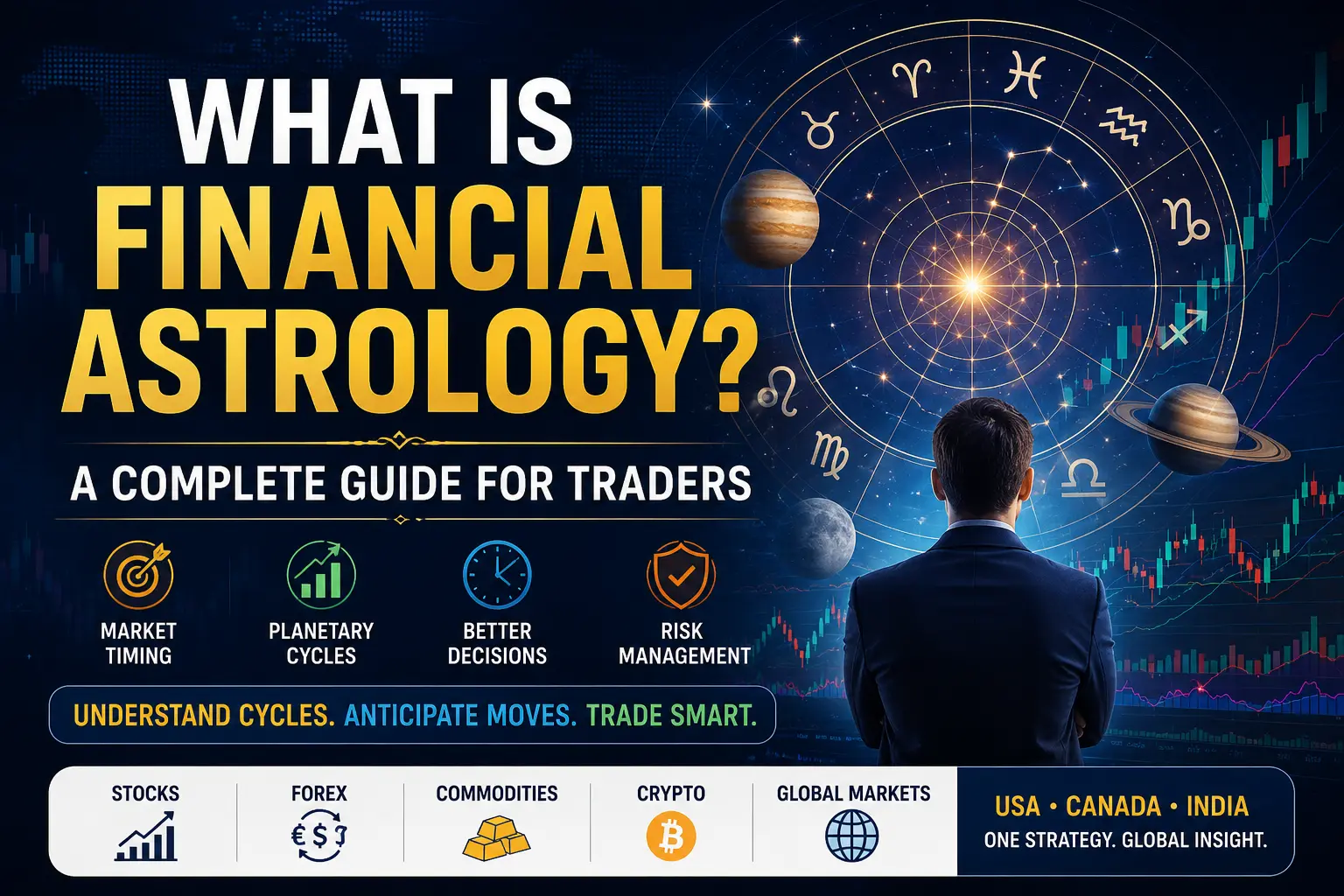
Financial Astrology Explained: Why Traders Are Exploring Market Timing
Financial Astrology: Why More Traders Are Looking Beyond Traditional Market Analysis
Financial markets have always been shaped by uncertainty. Economic reports, geopolitical events, corporate earnings, interest rate decisions, and investor sentiment all influence price movements every day. Yet despite the availability of advanced trading platforms, artificial intelligence, and sophisticated technical indicators, many traders continue searching for better ways to understand when significant market movements are likely to occur.
One area receiving increasing attention is Financial Astrology—a specialized branch of market analysis that studies planetary cycles alongside historical price behavior to identify potential periods of market volatility and trend changes.
While the concept may sound unconventional to some, Financial Astrology has existed for decades and continues to attract traders, researchers, and educators worldwide. Rather than replacing technical or fundamental analysis, it is often used as an additional analytical framework to study market timing.
Today, interest in Financial Astrology is growing across Canada, the United States, and India, where retail participation in financial markets has reached record levels. Traders are exploring multiple analytical approaches to better understand market cycles, improve discipline, and make more informed decisions.
Understanding Financial Astrology
Financial Astrology is the study of how recurring planetary cycles may correlate with recurring patterns in financial markets. The methodology focuses on timing rather than price prediction.
Unlike personal astrology, which analyzes individual birth charts, Financial Astrology examines broader planetary movements and compares them with historical market behavior. Analysts study decades of market data alongside astronomical events to identify recurring cycles that may coincide with important turning points.
Practitioners emphasize that Financial Astrology is not intended to replace traditional market analysis. Instead, it serves as an additional perspective that can be combined with technical analysis, market structure, volume analysis, and risk management.
This balanced approach is one reason the subject continues to gain interest among traders looking for a deeper understanding of market behavior.
Why Are Traders Becoming Interested?
Financial markets have become increasingly interconnected. News from one country can influence markets around the world within minutes, while advances in technology have made trading accessible to millions of new participants.
As competition has increased, traders have begun exploring analytical methods beyond traditional chart patterns.
Several factors have contributed to the growing interest in Financial Astrology:
- Increasing market volatility
- Global economic uncertainty
- Greater retail participation
- Demand for better market timing
- Long-term cycle analysis
- Alternative approaches to market psychology
Many experienced traders believe that understanding time can be just as important as understanding price.
Market Timing Versus Price Prediction
One of the biggest misconceptions about Financial Astrology is that it attempts to predict exact market prices.
Professional educators in the field generally explain that this is not its primary objective.
Instead, Financial Astrology seeks to identify periods when markets may become more active or experience significant changes in direction. These periods are then analyzed alongside technical confirmation before trading decisions are made.
This distinction is important because successful trading depends on probability—not certainty.
Whether a trader uses moving averages, Elliott Wave Theory, Fibonacci retracements, or Financial Astrology, every analytical method should be supported by disciplined risk management.
How Planetary Cycles Are Studied
Financial Astrology involves researching recurring astronomical events and comparing them with historical market data.
Some of the most commonly studied cycles include:
- Mercury Retrograde
- Jupiter–Saturn Cycles
- Lunar Phases
- Solar and Lunar Eclipses
- Planetary Conjunctions
- Heliocentric Cycles
Researchers compare these astronomical events with historical movements in:
- Stock markets
- Commodity markets
- Forex markets
- Cryptocurrency markets
The objective is to identify recurring relationships—not guarantees—that may provide additional context during market analysis.
A Complement to Technical Analysis
Technical analysis remains one of the most widely used trading methodologies in the world. It focuses on price action, support and resistance, indicators, volume, and chart patterns.
Financial Astrology approaches markets from a different angle by focusing primarily on time cycles.
When used together, the two methods can complement one another.
For example, if technical analysis identifies a strong support zone while Financial Astrology suggests an important timing window, some traders may pay closer attention to that period before making trading decisions.
This combined approach encourages patience rather than impulsive decision-making.
Global Markets and Financial Astrology
Although Financial Astrology has historical roots, its application today extends across major global markets.
Traders often study planetary cycles while analyzing:
- S&P 500
- NASDAQ
- Dow Jones
- TSX Composite
- Nifty 50
- Bank Nifty
- Gold
- Silver
- Crude Oil
- Bitcoin
- Forex currency pairs
This international relevance has contributed to growing educational interest in countries including Canada, the United States, and India.
As online education expands, more traders are looking for structured learning programs that explain how Financial Astrology can be integrated with conventional trading methods rather than used in isolation.
Education Is Driving Awareness
One reason for the increasing popularity of Financial Astrology is the availability of structured educational resources.
Instead of relying on fragmented information from forums or social media, traders now have access to dedicated courses that explain the subject in a systematic manner.
Among the educational platforms contributing to this niche is Art of Trading, which focuses on Financial Astrology, Market Timing, Technical Analysis, and Forex education.
The platform provides learning resources for traders interested in understanding how planetary cycles may complement technical market analysis.
Unlike promotional claims often seen online, structured education encourages students to combine multiple analytical approaches while maintaining disciplined risk management practices.
Why Financial Astrology Is Attracting Attention in Canada, the USA, and India
Interest in Financial Astrology has grown steadily over the past decade, particularly in countries with active retail trading communities such as Canada, the United States, and India. As access to online trading platforms has expanded, more individuals are looking beyond traditional indicators to understand broader market behavior and improve decision-making.
The popularity of financial education, algorithmic trading, and AI-powered market research has also encouraged traders to explore complementary analytical methods. While technical analysis remains the foundation for many professionals, market participants are increasingly interested in learning how time cycles may influence market psychology.
In North America, traders actively monitor markets such as the S&P 500, NASDAQ, Dow Jones, Gold, Silver, Crude Oil, and major Forex currency pairs. In India, the focus often includes Nifty 50, Bank Nifty, MCX Gold, Silver, and currency derivatives. Financial Astrology provides a framework that can be studied across all of these markets because it focuses on timing rather than individual companies.
Learning Financial Astrology Through Structured Education
Like any specialized field, Financial Astrology requires structured learning and continuous practice. Reading isolated articles or watching short videos may provide basic information, but developing a practical understanding of market cycles requires systematic education and historical research.
A growing number of educational platforms now offer dedicated programs covering Financial Astrology, market timing, technical analysis, and risk management. These programs aim to help traders understand how different analytical approaches can work together rather than relying on a single strategy.
One such platform is Art of Trading, an educational initiative focused on Financial Astrology, Technical Analysis, Forex education, and market timing concepts. The platform offers learning resources for beginners as well as experienced traders who want to expand their understanding of financial markets through structured training.
Art of Trading: Building Knowledge Through Practical Education
Rather than presenting Financial Astrology as a standalone solution, Art of Trading encourages traders to combine it with technical analysis, market structure, price action, and disciplined risk management.
Its educational approach focuses on helping learners understand the importance of probability, market cycles, and trading psychology while avoiding unrealistic expectations.
Among its educational offerings is the Financial Astrology Advance Course, which introduces learners to concepts such as planetary cycles, historical market analysis, and timing methodologies used by practitioners of Financial Astrology.
For traders interested in international markets, the platform also offers a Forex Currency & US Market Technical Analysis Course, designed to help students strengthen their understanding of Forex trading and major U.S. financial markets through technical analysis.
Explore the courses here:
Meet the Founder: Dhaval Patel
Behind Art of Trading is Dhaval Patel, an educator dedicated to helping traders understand Financial Astrology and market timing methodologies through structured learning. His work focuses on explaining how planetary cycles can be studied alongside technical analysis to develop a broader understanding of financial markets.
Rather than promoting certainty in market forecasting, his educational philosophy emphasizes disciplined research, practical learning, and responsible trading practices. This balanced approach reflects the growing demand for evidence-based financial education among traders worldwide.
Professionals and learners interested in his educational background can explore his professional profile on LinkedIn:
Dhaval Patel – LinkedIn Profile
Is Financial Astrology Right for Every Trader?
Financial Astrology is not a mandatory part of successful trading, nor is it intended to replace proven analytical techniques. Many traders achieve consistent results using technical analysis, fundamental research, or quantitative strategies alone.
However, for individuals interested in studying market cycles from multiple perspectives, Financial Astrology can offer an additional framework for understanding timing, volatility, and historical market behavior.
As with any educational discipline, traders should approach the subject with an open but analytical mindset, validate observations through research, and combine multiple forms of analysis before making investment decisions.
The Future of Financial Astrology Education
The trading industry continues to evolve as artificial intelligence, big data, and advanced analytics become increasingly common. At the same time, traders remain interested in understanding long-term market cycles and investor psychology.
Financial Astrology represents one of several alternative approaches being explored by traders seeking additional perspectives on market timing. As educational resources continue to improve, more traders are likely to study the subject—not as a replacement for conventional analysis, but as a complementary methodology within a broader trading framework.
The continued growth of online education platforms such as Art of Trading reflects this increasing interest in structured learning and responsible trading education.
Frequently Asked Questions
What is Financial Astrology?
Financial Astrology is a method of studying planetary cycles alongside historical market data to identify potential periods of market volatility and trend changes.
Can Financial Astrology predict stock prices accurately?
No. Financial Astrology should not be considered a guaranteed forecasting method. Most practitioners use it alongside technical analysis and risk management.
Who can learn Financial Astrology?
Anyone interested in financial markets—including beginners, investors, swing traders, Forex traders, and market researchers—can study Financial Astrology through structured educational programs.
Is Financial Astrology popular outside India?
Yes. Interest in Financial Astrology exists among traders in countries including Canada, the United States, Australia, the United Kingdom, and several European markets.
Where can beginners learn Financial Astrology?
Beginners can start with structured educational platforms such as Art of Trading, which offers courses covering Financial Astrology, Technical Analysis, Forex trading, and market timing concepts.
Final Thoughts
Financial markets are influenced by numerous economic, political, and psychological factors. While no analytical approach can eliminate uncertainty, studying different market methodologies can help traders develop a broader perspective.
Financial Astrology continues to attract interest because it encourages traders to think about time in addition to price. When combined with technical analysis, disciplined risk management, and continuous learning, it can become another valuable tool within a trader's educational journey.
For readers interested in exploring this field further, structured education through platforms such as Art of Trading provides an opportunity to learn Financial Astrology and market timing concepts in an organized and practical manner.
Disclaimer: This article is intended for educational and informational purposes only. Financial Astrology is an alternative market analysis methodology and should not be interpreted as financial or investment advice. Readers should conduct their own research and consult qualified financial professionals before making investment decisions.